
A useful psychic review tells you what the customer bought, what happened and how the service handled costs or concerns. A high star rating or an emotional testimonial gives less information on its own.
Compare reviews by service details, relevance, verification and commercial incentives. Treat prediction claims as personal accounts, then check the current offer before paying.
What a review can—and cannot—tell you
| Review detail | Useful signal | What still needs checking |
|---|---|---|
| The answer arrived within two days | Reported delivery experience | Today's delivery policy |
| The charge matched the displayed rate | Reported billing experience | Current fees, renewals and spending limits |
| I felt understood | The reviewer's personal response | Whether the style suits you |
| Every prediction came true | A claim requiring more context | Original wording, dates, misses and total readings |
| Verified purchase | A platform-specific transaction check | What the platform actually verified |
Scroll sideways to see the full table.
Pay Attention to Verifiable Details
Service details are a good part of a review. Did the reading start on time, and was the agreed format delivered? Did the total charge stay the same as the stated price, or were questions about billing answered clearly?
These details can help you choose whether a service is organized and whether it fits your needs. They still show one person’s account, so you need to compare them with the current policies and other sources. A review of an email reading doesn’t always talk about the same service as a live video reading.
Emotions also matter. A person may have felt comforted, understood, disappointed, or scared. That’s their reported experience and not a promise about what you’re going to feel. Someone who wants direct conversation might not like the same style of another customer who finds it clear.
Prediction claims need more caution. If they say that everything came true, it’s hard to assess this without their original wording, the timing, and the context. Look at this statement as a testimonial and not an accuracy recording.
Understanding Reviews
A detailed story can feel more trustworthy than a short compliment. Details help make it easy to understand the experience, but they don’t prove that the account is real or complete. A review that’s made up can include specifics, and an honest customer might write only one short sentence.
The Federal Trade Commission's guide to evaluating online reviews warns that appearance alone cannot reliably distinguish genuine reviews from fake ones. It recommends considering different sources and looking at context such as reviewing timing and reviewer history.
Use these kinds of observations to figure out where to investigate further, not to say that a stranger is lying. A bunch of reviews might show a marketing campaign, a new service launch, or even manipulation. A new account might belong to a real first-time reviewer.
The goal is to make a reasonable purchasing decision under uncertainty. You don’t have to identify everyone who does a review before deciding whether a provider has too little information to meet your needs.
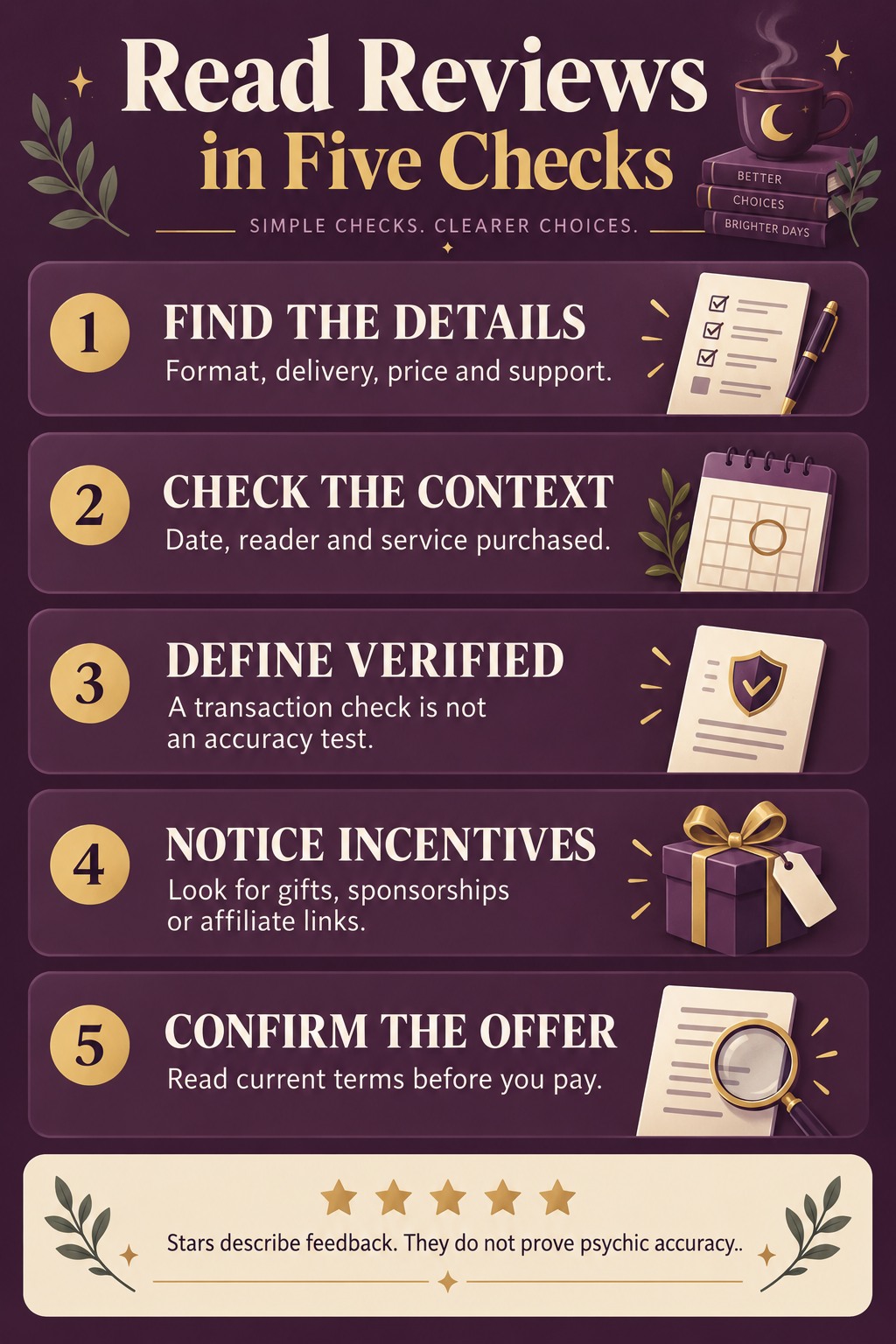
Read Reviews in Five Checks: visual guide

Read the infographic as text
- 1. FIND THE DETAILS: Format, delivery, price and support.
- 2. CHECK THE CONTEXT: Date, reader and service purchased.
- 3. DEFINE VERIFIED: A transaction check is not an accuracy test.
- 4. NOTICE INCENTIVES: Look for gifts, sponsorships or affiliate links.
- 5. CONFIRM THE OFFER: Read current terms before you pay.
Check Who Controls the Review Page
Where you find a review can matter just as much as what the review actually says. Testimonials on a psychic reader’s own website are usually picked by the reader or the company, so they have some control over which ones you see. That does not automatically mean the reviews are fake, but it does mean you might not be seeing what every customer had to say.
The same thing can happen with comparison websites that seem independent. Some of these sites make money when you click one of their links and book a reading. Look for information about things like affiliate links, sponsored recommendations, free readings, or anything else the reviewer might have received. None of this automatically means you cannot trust the review, but it is still something you should know before deciding how much weight to give it.
It is also a good idea to check whether the person writing the review actually used the psychic service they are recommending. There is a difference between someone comparing things like prices, website features, and the readers available and someone talking about a reading they personally paid for. Both can give you helpful information, but you should know which type of review you are reading.
When every provider gets the same praise, look for clear comparison criteria. Check whether the page distinguishes price, delivery, reader selection and support rather than repeating a sales pitch.
Understand What “Verified” Really Means
Words like verified purchase or verified customer can sound more meaningful than they actually are. Usually, they mean that the website has some type of process for connecting the review to a transaction or customer account. They do not mean that everything written in the review has been proven true or that the review represents everyone’s experience.
If the website explains its verification process, take a look at what it actually checks. On one site, “verified” might mean that the person made a payment. Somewhere else, it might mean that an appointment was completed or even that an email address was confirmed. The same label can mean different things depending on the website.
The same idea applies when you see a verified reader or verified profile label. The platform might have checked the person’s identity, account information, or other requirements used by that particular company. Do not automatically assume that the label means the reader’s psychic gifts were independently tested or proven. If that verification matters to you when deciding whether to book, find out what the company actually verified.
An easy way to think about it is to finish this sentence: “Verified means this website checked…” If you cannot figure out how to finish that sentence from the information the website provides, do not give the label more meaning than you actually know it has.
Relevant Experiences
Services might always change. Prices, refund policies, formats, and certain readers might be different from an older review. Always check the date and compare the claims with the current information before you take them as true.
Relevance also matters. A review from one reader on a big platform doesn’t mean every reader will act the same. A complaint about a platform’s payment system might give more information, but you still need to understand the issue.
Match the reviews with how you intend to use the platform. If you want a short-written response, then feedback about a big group event might not answer the questions you have. If privacy matters most to you, then comments about the atmosphere of the site might be less useful than a recording of data practices.
You don’t have to ignore older reviews or repeated descriptions of the same unresolved issues over a long period of time. Pay attention if later evidence shows a change, instead of just thinking that the age makes the review something you should ignore.
Claims of Accuracy
Someone who leaves a review might talk about a statement that felt impossible for the reader to know. You can pay attention to why this mattered to them without thinking that you have enough information to explain how it happened.
Ask yourself what’s missing from the account and whether the wording was recorded before the event. Ask if the statements were made and if details were volunteered during the conversation.
Avoid taking a collection of success stories and turning them into a percentage. 10 amazing testimonials don’t tell you how many readings happened, how success was defined, or what happened in the readings that weren’t described.
You can still pick a reader because their approach interests you but keep the choice separate from claims that reviews have been scientifically proven. A review page should be designed to describe experiences, not as a test.
Read Negative Reviews with the Same Care
A bad review can definitely tell you something important, but not every negative review means that the reader or company did something wrong. Sometimes a person simply did not like the reader’s style, did not get the answer they were hoping for, or misunderstood what was included in the service they purchased. Instead of looking only at the number of stars, take a little time to read what the person says actually happened.
Pay more attention to specific complaints about things like unexpected charges, being pressured to purchase more services, a reader not respecting someone’s boundaries, or private information being shared. If you start seeing several people describe the same type of problem, that is something worth paying closer attention to.
It also helps to separate what actually happened from how the reviewer felt about it. For example, saying, “My reading only lasted eight minutes,” gives you something specific that you can look into. Saying, “This reader obviously does not care about anyone,” is more of a personal opinion. Both can matter to the person writing the review, but they do not give you the same kind of information when you are trying to decide whether to book.
You also do not need to contact reviewers and ask them to share private messages, transcripts, or personal details about things like their grief, relationships, or health. It is understandable to want to know whether a complaint is legitimate, but another person’s private information is still theirs to keep private.
Notice How a Business Responds
How a business responds to a complaint can sometimes tell you just as much as the original review. Look at whether the company explains its policy, addresses the actual concern, or gives the customer a private way to discuss the problem. Also pay attention to whether the response starts sharing personal information or attacking the customer instead of dealing with the complaint.
A polite response does not automatically mean that everything was handled correctly. Some companies use standard replies that sound reassuring without really explaining what happened. At the same time, a short response is not always a bad sign. The business might simply be trying not to discuss someone’s private situation in public.
Be especially careful if a response tells the customer that a prediction failed because they doubted the reading or did not believe enough. The same goes for claims that the customer now needs to purchase another reading or service to fix the problem. At that point, the conversation has moved away from what the person originally paid for and can start creating pressure to spend more money.
A good response should still leave room for the customer to disagree. You do not need to see a business win every argument in the review section. What matters more is whether the terms are clear, boundaries are respected, and there is a reasonable way to handle a problem when something goes wrong.
Understanding Incentives
Free readings, discounts, contest entries, and affiliate payments can influence how reviews are asked for and presented. An incentive doesn’t prove dishonesty, but the reader should be able to know about relevant relationships and limitations of the reviews.
The FTC's explanation of its Consumer Reviews and Testimonials Rule describes prohibited practices under United States federal rules, including certain fake reviews and incentives conditioned on positive or negative sentiment. The guidance has a specific legal context; it is not a universal summary of every country’s law.
When making a decision, you should focus on transparency. Was the reward disclosed, and does the page explain how reviews are collected or moderated? Are critical experiences allowed, and is there a selection process that’s understandable?
Don’t just think that a review that mentions AI was automatically made up. A real customer might use writing assistance. The important issue is whether the review shows a real experience accurately, not whether you can guess which writing tools were used.
Comparing Reviews
If you’re thinking about getting a 20-minute chat reading, a review might say that there’s amazing energy and it was life-changing. Another one might say the chat started on time, the rate was easy to see, and the reader stopped when I said my budget was reached.
The first shows excitement, and the second gives details that are relevant to your own booking. Neither gives psychic accuracy, but the second one helps you see questions to confirm before you pay.
A third review might say that they were charged more than was expected, and this matters. Still, you still need to know whether the issue was about extra minutes, automatic renewals, currency conversion, or an unauthorized charge. Pay attention to the current terms instead of inventing the missing explanation.
The best outcome would be to ask when billing starts and if spending can be capped. Reviews have then helped you know what kind of decision you’re making before you make a purchase.
Creating a Record
For each of the services, write down one useful observation and one unanswered question. Keep the record small enough that comparing providers doesn’t become an endless search for certainty. A few important details are more useful than a huge score that gives little evidence.
A short comparison note might read: “Customers report fast delivery; follow-up pricing remains unclear. Confirm the current terms before booking.” This is a fictional example of recording an observation and a question, not a review of a particular service.
If a question affects your privacy, spending, or comfort, solve it before you ever book. If the provider doesn’t explain it, you can pick another service or decide not to purchase a reading at all.
Always keep your own personal limits independent of the reviews. Exciting testimonials shouldn’t make you spend more money or give unnecessary information.
Check the Promise of the Purchase
Reviews may describe offers that are no longer available. Before you pay, read what the package gives you and confirm the delivery period, included questions, cancellation terms, and the overall total price. Save a copy of the offer that you’re accepting so you can look at it later.
If a review tells you that a reader gave unlimited follow-up answers, don’t think that the benefit is included today. Ask the provider to clarify any differences in writing. Taking the small step can turn a question into a concrete answer, so you can understand your own purchase.
Final Thoughts: Knowing When to Stop
Watch for urgent curse-removal payments, guaranteed financial rewards, or escalating fees. The United States Postal Inspection Service's psychic-scam guidance identifies promises and continuing demands for money as warning signs and encourages checking total costs.
If you run into pressure directly, you don’t have to compare the star ratings, but save the relevant information in the transaction, stop making further purchases, and get the right payment provider help you need for your situation.
For a regular reading booking, the best outcome is a clear understanding of the format, privacy terms, costs, and limits. A service can be exciting to you without your unquestioning trust.
Read your psychic reviews with curiosity but also let the details help you ask better questions. Let your personal stories stay personal. Don’t make your final decision until you know your own needs and boundaries.
For practical checks on the service itself, see how to assess a psychic network.
For the next step, explore how psychic services are reviewed, recognising a psychic scam.
Frequently asked questions
1. Can five-star reviews prove a psychic is accurate?
No. Star ratings show reported satisfaction, not a controlled test of predictions. A review needs context about wording, timing and missed claims before an accuracy claim can be evaluated.
2. What details make a review useful?
Look for the format purchased, delivery time, total charge, included questions and handling of a concern. Specific service details help you know what to confirm before booking.
3. Does verified purchase mean the review is true?
It normally means the platform linked the review to a transaction or account using its own process. It does not establish that every statement is correct or representative.
4. Are reviews on a reader's own website independent?
The reader or business controls that page and may select testimonials. Use them alongside current policies and other sources rather than assuming they represent every customer.
5. How should I assess an affiliate review site?
Look for a clear disclosure and an explanation of how services were compared. Commercial incentives do not automatically make a review false, but they matter when weighing recommendations.
6. Are negative reviews more trustworthy?
Not automatically. Separate specific events from interpretation and emotion. Repeated reports of unexpected charges or pressure deserve attention, while a style mismatch may not apply to your needs.
7. Should I ignore old reviews?
No, but compare them with current services and policies. An older unresolved pattern can still matter; an old price or discontinued format may be less relevant.
8. Does a cluster of reviews prove manipulation?
No. A launch or review-request campaign can create a cluster. Treat unusual timing as a reason to investigate, not as enough evidence to accuse someone of fraud.
9. Can I identify fake reviews by their writing style?
Writing style alone is unreliable. Real customers can write briefly, awkwardly or with assistance, and fabricated reviews can contain persuasive detail. Check context instead.
10. What should I look for in a business response?
Look for an explanation of the relevant policy and a private route to resolve the issue. Sharing personal details, attacking the reviewer or demanding more purchases are concerning responses.
11. Do free readings affect reviews?
They can influence what is reviewed and how it is presented. Check whether the incentive is disclosed and whether critical feedback is allowed. Rules about incentives vary by jurisdiction.
12. Can a handful of testimonials become an accuracy percentage?
No. You would need the total number of readings, a clear definition of success and a record of both matches and misses. Selected testimonials do not supply those data.
13. How many reviews should I read?
Read enough to identify relevant patterns and unanswered questions. There is no magic number. Stop when further scrolling adds little, and confirm the details that affect your purchase.
14. What warning signs should make me pause?
Be cautious about curse-removal demands, guaranteed rewards, urgent pressure and escalating fees. Keep your spending limit and use appropriate payment-provider support for a disputed charge.
15. What should I check immediately before booking?
Confirm the selected reader, total price, format, delivery window, follow-up terms, refund policy and privacy arrangements. Reviews may describe offers that no longer exist.