
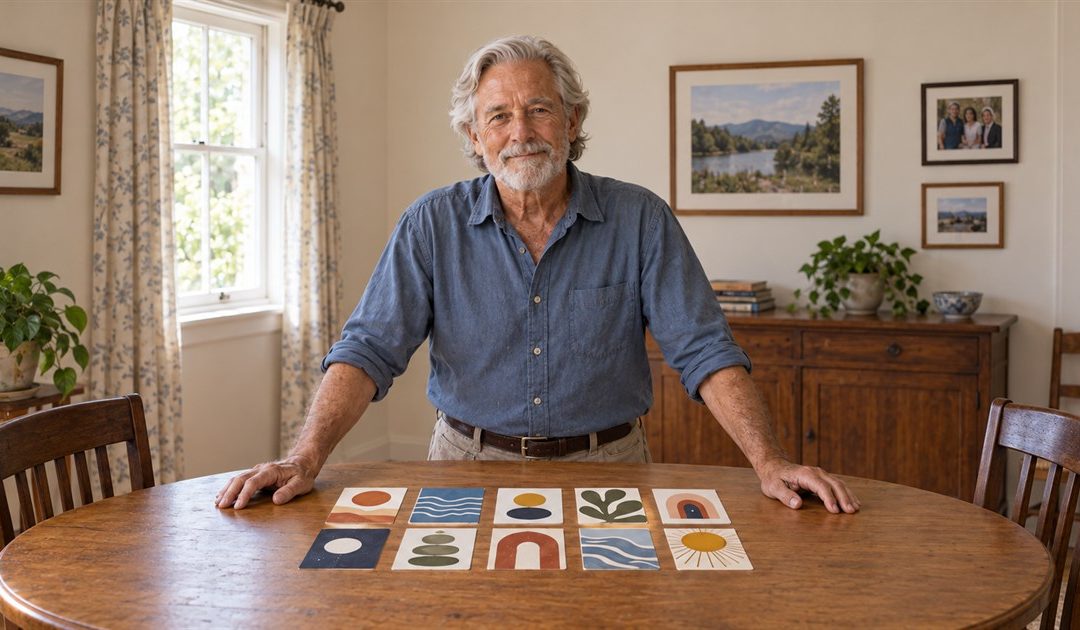
This ten-card tarot spread is designed to help you reflect on a choice, not to prove that you are on the “right path.” Each position asks a different practical question, from what you know to what you need to verify. The final step is a small action you choose, with a way to review it afterward.
Editorial correction: the earlier article described ten named cards as proof of good decisions and future happiness. Those guarantees have been removed. The same card names appear in the fictional example below, but their interpretations are optional prompts rather than predictions.
Quick guide
- Format: ten positions in two rows of five, read left to right.
- Purpose: explore one manageable choice and identify missing information.
- Not a forecast: a card does not establish facts, consent or a guaranteed result.
- Finish: choose a reversible step and a review question; do not keep drawing for certainty.
What this spread is—and is not
This is an original editorial layout, not the traditional Celtic Cross or a historically attributed ritual. Its ten positions deliberately separate observations, assumptions and actions. You may use a tarot deck you already own, or simply answer the written questions without cards.
For historical context, the Morgan Library & Museum describes tarot’s origins as a fifteenth-century Italian card game. That history is distinct from claims that a modern spread reveals destiny. We are not presenting our layout as an ancient method or a clinically validated exercise.
If you are considering a paid session instead of a personal exercise, our guide to reading benefits, limits and preparation explains what to check before booking.
Set up one focused question
Choose something with room for reflection: “What should I consider before joining this class?” is more workable here than “Will my whole life turn out well?” Avoid using the spread to diagnose symptoms, make investment choices or infer another person’s private thoughts.
Write your question before selecting cards. Decide whether you will use reversed cards; for a simpler exercise, keep them upright. Neither approach makes the result more factual. Shuffle or select cards in your usual way, then place ten cards in two rows. Positions 1–5 go across the top; 6–10 go across the bottom. Read the positions in numerical order.
There is no need to buy a special deck, cleanse the room or keep drawing until the result feels favorable. If ten cards feel like too much, use only the written prompts or stop after identifying one useful question.
The ten positions
- Your priority: What matters most about this decision?
- Known facts: What do I actually know, and where did the information come from?
- An assumption: What am I treating as certain without checking?
- Available resources: What skill, time or practical support is already available?
- A constraint: Which real limit needs to be respected?
- Another option: What alternative have I not considered?
- A boundary: What am I not willing or able to agree to?
- Useful support: Who can help with the specific information or task?
- A small experiment: What reversible step could I try?
- A review question: What will I check afterward to decide whether to continue?
At each position, distinguish the image you see from the story you attach to it. “This card shows a road” is an observation about artwork. “I must move away” is an interpretation and a proposed action. There may be other interpretations, and you are free to reject all of them.
Worked fictional example: choosing a weekend class
Imagine an adult deciding whether to enroll in a ceramics class. The following ten cards were deliberately selected for this example, not drawn in a real session. These are our illustrative associations, not universal card meanings. A different deck or reader may use different imagery and language.
On a small screen, scroll the example table sideways to read the full reflection.
| Position | Example card | Possible reflection |
|---|---|---|
| 1 | The Star | I want room for creativity, not a guaranteed new career. |
| 2 | Justice | I need the actual course price, schedule and cancellation terms. |
| 3 | The Chariot | I am assuming enthusiasm will make travel time manageable. |
| 4 | Eight of Pentacles | I already enjoy practicing a skill regularly. |
| 5 | Six of Swords | Travel is a real constraint; a nearer class may fit better. |
| 6 | The Emperor | A structured short workshop is another option. |
| 7 | King of Wands | I will not agree to organize a group before trying the class. |
| 8 | Queen of Wands | I can ask the tutor about access and beginner support. |
| 9 | Judgement | I can try one introductory session before committing. |
| 10 | Ten of Cups | I will check enjoyment, cost and schedule fit—not predict lasting happiness. |
The useful output is not “The Star confirms success.” It is a short task list: check the course details, ask about access, compare travel demands and decide whether one introductory session is affordable. Those actions remain useful even if you set the cards aside.
Suppose the timetable does not fit. That fact outweighs a reassuring interpretation. You can choose another class without deciding that you failed a spiritual test or missed your only opportunity.
The reality check before acting
Separate each proposed action from the reading and ask whether it still makes sense. A symbolic prompt may suggest a question; evidence must do the work of answering factual parts of it.
- Check the claim: what would have to be true for this action to be sensible?
- Find the source: can I verify it with the relevant person, written terms or a qualified professional?
- Consider another explanation: am I interpreting a general image to fit what I already wanted?
- Respect other people: does this involve consent, privacy or a boundary I cannot override?
- Limit the downside: is there a smaller, reversible step that does not create avoidable cost or risk?
Our measurable planning guide can help turn an idea into an action you can review. You do not need to attribute the idea to a supernatural source for it to be worth considering.
A journal page that keeps the record honest
Use a brief note rather than a long narrative if that is easier. For one position, record:
- Question and date: what was I exploring before I saw the cards?
- Card and position: what actually appeared, without changing the layout afterward?
- First interpretation: what did it suggest to me?
- Alternative: what else could the same image suggest?
- Evidence needed: what remains unknown?
- Chosen action: what will I do, if anything?
- Review: what happened, and what did not fit my original expectations?
A record that includes misses and uncertainty is more informative than a retelling that remembers only apparent matches. If the exercise becomes repetitive reassurance-seeking, pause it. More cards do not oblige the world to provide a clearer answer.
A worrying card is not a warning you must obey
Do not treat an image as evidence of illness, betrayal, death or an approaching disaster. You may skip a card, stop the exercise or speak to someone you trust. Do not pay for a cleansing or another reading to neutralize it. Real symptoms and safety concerns belong with appropriate professional or emergency support, not a card interpretation.
Keep the decision yours
You may finish with a useful question, an ordinary next step or no new insight. All three are possible. The point is not to make every card fit or to secure a verdict that your life is on course.
For a card-free alternative, try our values-and-commitments check-in. It asks what matters, what limits you face and which action is feasible without requiring a spiritual label.
Source scope: the Morgan source supports only the brief historical context. The layout, card associations, fictional scenario and journal prompts are original editorial material. They are not research findings, a traditional spread attribution, a treatment protocol or evidence of predictive accuracy.
Frequently asked questions
What does each position in this ten-card spread mean?
The positions cover your priority, known facts, assumptions, resources, constraints, an option, a boundary, support, a small experiment and a review question. They are original reflection prompts, not established predictions or a traditional Celtic Cross layout.
Can this spread confirm that I am on the right path?
No. The cards can prompt ideas, but they cannot establish that a choice is correct or guarantee an outcome. Check relevant facts, consider alternatives and keep consequential decisions grounded in appropriate evidence.
How should I journal the result?
Record the card and position, your first interpretation, an alternative interpretation, the facts that need checking and one action you choose. Return to what actually happened rather than revising the original interpretation to fit the result.
What if I draw a card that worries me?
A card is not evidence that something bad will happen. You can skip it, put the deck away or use the written question without a card. Do not buy another reading or a cleansing service to cancel an alarming interpretation.