
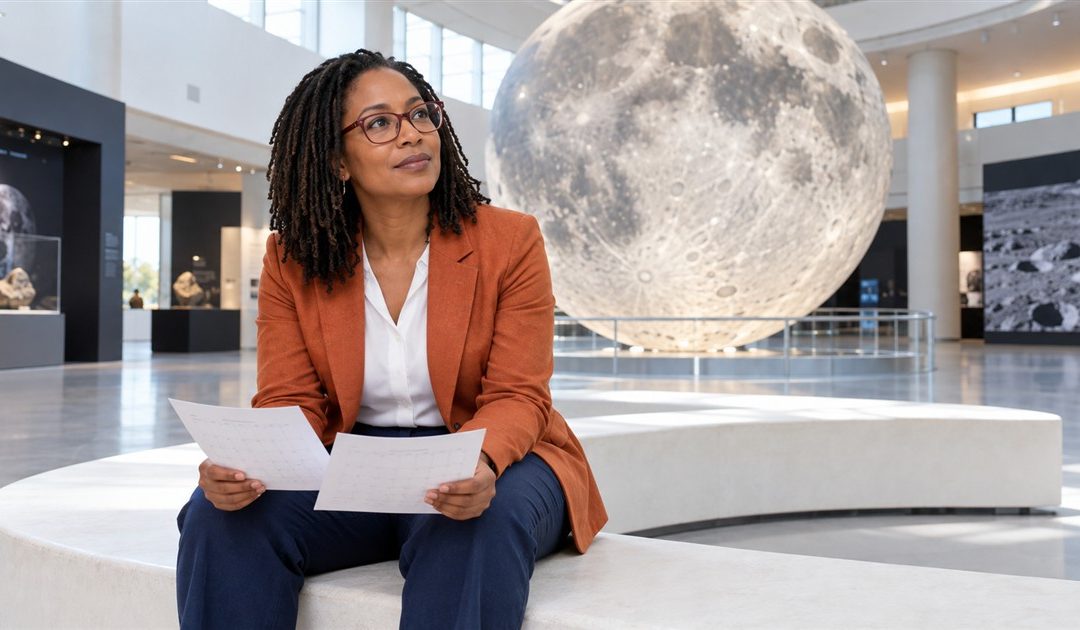
Moon phases do not provide a reliable timetable for women’s moods, periods or decisions. Research into lunar timing and menstruation is mixed: some studies report associations, while others find none. That uncertainty does not justify telling every woman that she will feel drained at a new moon, emotional at a full moon or fertile on a particular lunar date.
Lunar symbolism can still be meaningful as a personal or cultural practice. The key is to distinguish a chosen metaphor from a biological rule—and to judge health concerns by symptoms, not whether a cycle matches the sky.
Quick guide
- Two different cycles: lunar phases describe our view of the Moon; menstruation involves a person’s hormonal cycle.
- Evidence: researchers disagree about the strength and consistency of lunar associations. Individual prediction is a separate question.
- Health: pain, unusual bleeding or concerning changes deserve appropriate advice, regardless of the phase.
- Symbolism: you may use the Moon as a reminder to reflect, but you do not have to organize your life around it.
Why the cycles seem connected
NASA describes the lunar phase cycle as lasting about 29.5 days. The U.S. Office on Women’s Health explains that menstrual cycles vary and gives a typical adult range of 24 to 38 days. Similar average timescales can make the connection seem intuitive, but similarity alone does not show that one cycle controls the other.
Two repeating events can line up for a while and then drift apart if their lengths differ. A few matching dates are therefore not enough to establish a cause. It also matters what counts as a match: the exact day, several days around it, the full moon, the new moon or either one. A broader definition makes coincidences easier to find.
Women also do not share one reproductive experience. Not all women menstruate, and not everyone who menstruates is a woman. A lunar story should not become a test of femininity, fertility or spiritual worth.
What the research actually shows
Two studies illustrate why the answer needs qualification:
A study finding no overall menstrual-phase association
A 2021 study by Komada and colleagues examined recent menstrual records from 529 women aged 25–39. It found no overall association between menstrual onset and lunar phase. It also reported some relationships involving self-reported sleep quality, which are different findings from a universal pattern of menstruation.
A later study reporting temporary synchronization
A 2025 study by Helfrich-Förster and colleagues analyzed 176 long-term menstrual records and reported lunar synchronization that varied over time, including weaker alignment in more recent records. The authors proposed explanations involving artificial light and gravitational cycles.
Those records were retrospective and came from Northern Hemisphere participants who were not using contraceptive medication. The findings do not establish that every person’s cycle should align with a particular phase, and proposed mechanisms should not be turned into instructions to “repair” your cycle with moonlight.
Our interpretation: this is an active research question, not a basis for promising that lunar calendars can predict an individual’s period, fertility or mood. These studies use different datasets and methods; counting one as proof and ignoring the other would give an incomplete picture.
What about mood, energy and sleep?
A study about menstrual timing does not automatically answer a question about emotions, behavior or sleep. Those outcomes need to be measured separately. Claims that all women become tense at full moon or lose energy at new moon go well beyond the evidence summarized here.
The Office on Women’s Health’s PMS guidance describes emotional and physical symptoms that can occur before a period and notes possible sensitivity to hormonal changes. That is different from assuming the same symptoms are caused by the Moon.
If you notice changes, pay attention to what is happening in your life: sleep, symptoms, responsibilities and recent changes in care or routine. Avoid dismissing yourself or another person as “just affected by the full moon.” If symptoms interfere with daily life, ask a qualified professional for help.
How to keep a useful record without forcing a pattern
A personal log can organize information for a conversation with a clinician. It is not an experiment that can prove lunar causation or a substitute for care.
- Record events when they happen. Note period start dates if relevant, symptoms, sleep and anything you want to discuss. Avoid reconstructing only the memorable days later.
- Use the same descriptions. For example, choose a simple consistent way to describe pain or energy rather than changing the standard to fit an expectation.
- Keep lunar notes separate. If you want to include the phase, add it as an observation rather than a diagnosis. Do not write “Moon-caused anxiety” when what you know is “felt anxious.”
- Include mismatches. Record ordinary days and instances when your expectations did not fit, not just striking coincidences.
- Bring concerns to a professional. The useful result may be a clearer description of symptoms, even if no lunar pattern emerges.
Keep the record brief and private. If tracking makes you more worried or preoccupied, you can stop and discuss a simpler approach with a clinician. You do not need a paid app or a special lunar journal.
Keeping the symbolism without the pressure
If you like a lunar framework, make it an optional set of reminders rather than a schedule your body must follow. You might associate a new moon with choosing a question, a waxing phase with taking a small step, a full moon with reviewing progress and a waning phase with simplifying a commitment.
These are editorial reflection prompts, not biological predictions or a claim that all traditions use the same meanings. You can swap them, skip them or reflect on an ordinary Tuesday. Rest when you need rest and act when circumstances call for action; you do not have to wait for a phase.
Our guide to full-moon symbolism and low-risk rituals explores the cultural and personal side in more detail. For a reflection method that does not depend on the lunar calendar, see mindfulness for beginners.
Key takeaways
- Similar cycle lengths are a reason to investigate, not proof of control.
- Studies have reported different results; none of the findings summarized here creates a universal schedule for women.
- Menstruation, mood, sleep and fertility are distinct questions.
- A period does not need to match the Moon to be valid or healthy.
- Keep spiritual symbolism optional and health decisions grounded in appropriate care.
Source scope: NASA supports the astronomy, the Office on Women’s Health supports the menstrual-health context, and the cited studies illustrate differing research findings. The practical cautions and reflection prompts are editorial guidance, not a medical assessment or systematic review.
Frequently asked questions
Do moon phases control menstrual cycles?
Research findings are mixed, with some studies reporting associations and others finding none. This does not establish a universal lunar timetable for periods or a reliable way to predict an individual’s cycle.
Does the full moon make women more emotional?
A lunar phase is not a reliable explanation for how an individual woman feels. Consider actual symptoms and circumstances rather than assuming that a full moon determines mood or behavior.
Is a period that does not match the Moon abnormal?
Not because of the mismatch. Menstrual health is not judged by alignment with a lunar phase. If you have concerns about pain, bleeding or changes in your cycle, speak with a qualified health professional.
Can I still use moon phases for personal reflection?
Yes. You can choose lunar phases as calendar reminders or metaphors, provided you keep that symbolism separate from medical claims and do not use it to override your needs or decisions.